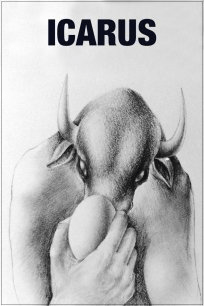
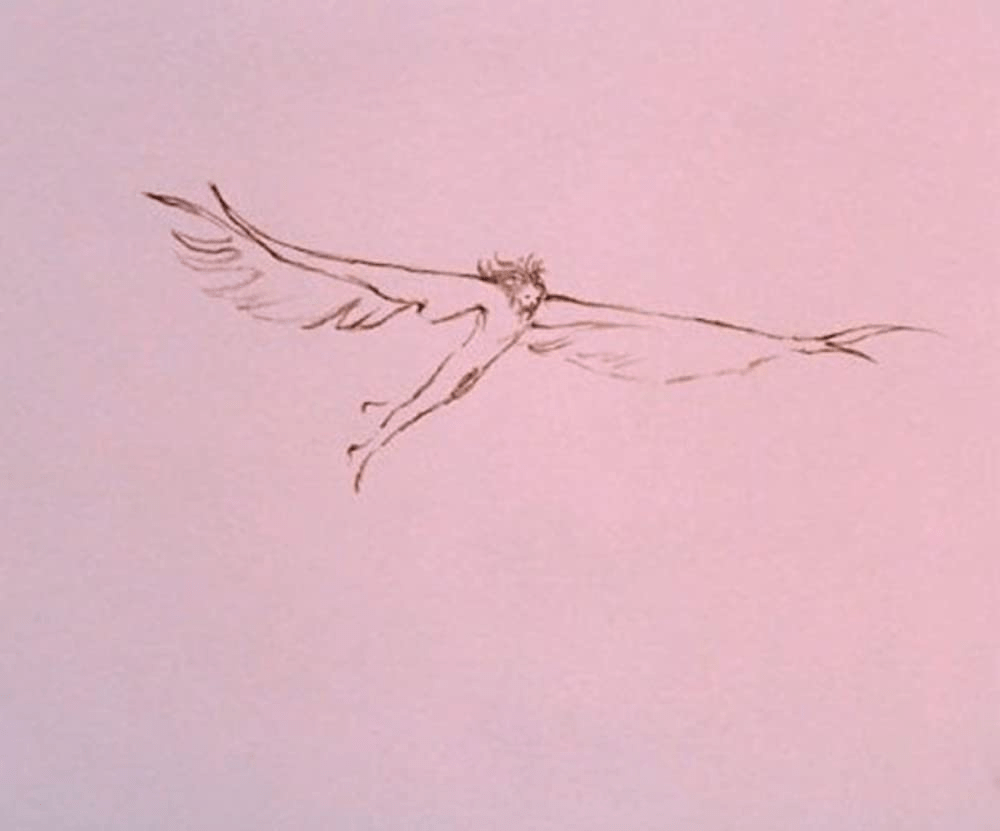
In this hand-drawn, meditative short made up of naturalistic sketches, Bochner retells the classic tale of Icarus; however, he puts a unique emphasis on the idea of the body as a prison, and on the shared hybridity of the Minotaur and of the “Bird-men” that Daedalus & his son become when they don their wings. The film ends on a cosmic note, reminiscent of Phaethon, as Icarus flies beyond the atmosphere into space, only to fall.
This delightfully bizarre short begins with a young Porky Pig reading a bedtime story from a Greek myths book. He’s apparently reading the story of the Gorgon, who turned everyone she looked at into stone and was only prevented from changing every Greek into a statue by a vanquishing hero. He falls asleep wishing he could be a hero and dreams of being transformed into Porkykarkus, apparently a nod to the stage persona Parkyakarkus that was used by comedian Harry Einstein – this is one of many topical references that are stuffed into this short. Porky is hired by the Emperor Jones to sneak into the Gorgon’s statue factory, where she uses her “marvelous photographic eye” to petrify her subjects, and to steal the “bring-em-back-alive” syringe that she wears around her neck. We see the Gorgon, a lanky old lady in an Egyptian-ish headdress and a parody of a popular 1930s radio character called Lizzie Tish, hard at work. Porky dawns the appearance of a idealized male statue to trick and seduce the Gorgon, and he is able to retrieve the needle. He the sets out on the run, turning statues back into living men and women, and even animating a temple (a “Shirley Temple”) along the way. He is apprehended the Gorgon, who orders him to open his eyes, but he awakens at that moment only to realize it is actually his mother, rousing him from sleep.
This description does not do justice to the wild creativity on display in this cartoon. It is a must watch, with cameos by the Three Stooges, Popeye’s arms, the Discoboulos, and the creators themselves.
Seven episodes; 10 min. each; Romania (no subtitles); dir. Luminiţa Cazacu
The “Penelope and Odysseus” series is made up of seven episodes that take on the story of the heroic couple from a comical feminist perspective in a precious visual style. The films include:
1976 Condiţia Penelopei (Penelope’s Condition)
1977 Penelopa și cele 9 muze (Penelope and the 9 Muses)
1977 După amiezile Penelopei (Penelope’s Afternoons)
1979 Penelopa în templul artei (Penelope in the Temple of Art)
1980 Maratonul Penelopei (Penelope’s Marathon)
1980 Penelopa și Scufița Roșie (Penelope and Little Red Riding Hood)
1981 Penelopa și uriașii cei răi (Penelope and the Wicked Giants)
In each film, the long-suffering heroine of the Odyssey is depicted as “the embodiment of calm and patient, gentle and forgiving femininity,” as she deals with different challenges typically faced by women in contemporary society — e.g., male prejudice, professional achievement, jealousy, the rigors of fashion, stress and the many demands on women’s time — though she always forgives Odysseus’ transgressions. The films treat these issues in a humorous way, often tinged with light irony and sarcasm, which is introduced by off-screen commentators (famous Romanian actors Toma Caragiu and Octavian Cotescu).
Part of the films’ humor also derives from the juxtaposition of elements of modern civilization, such as electric appliances, appearing in the ancient setting (a la The Flinstones).
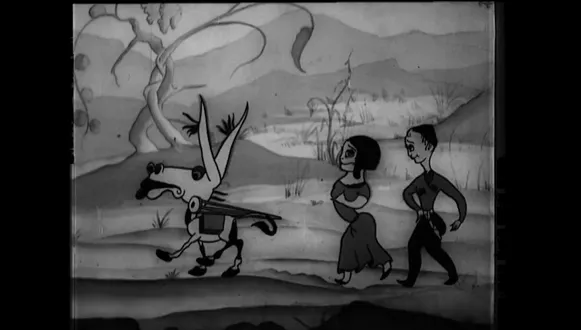
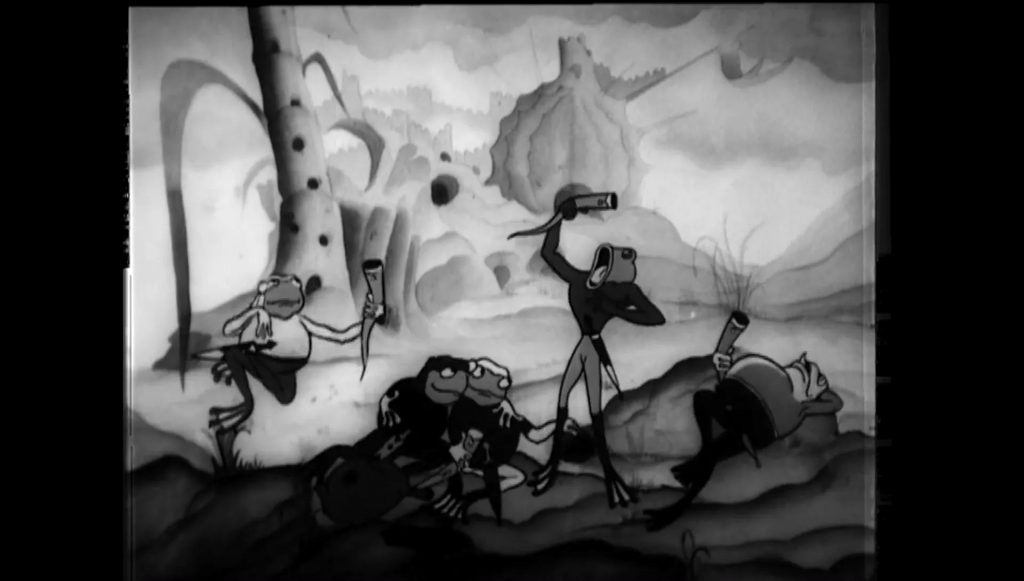
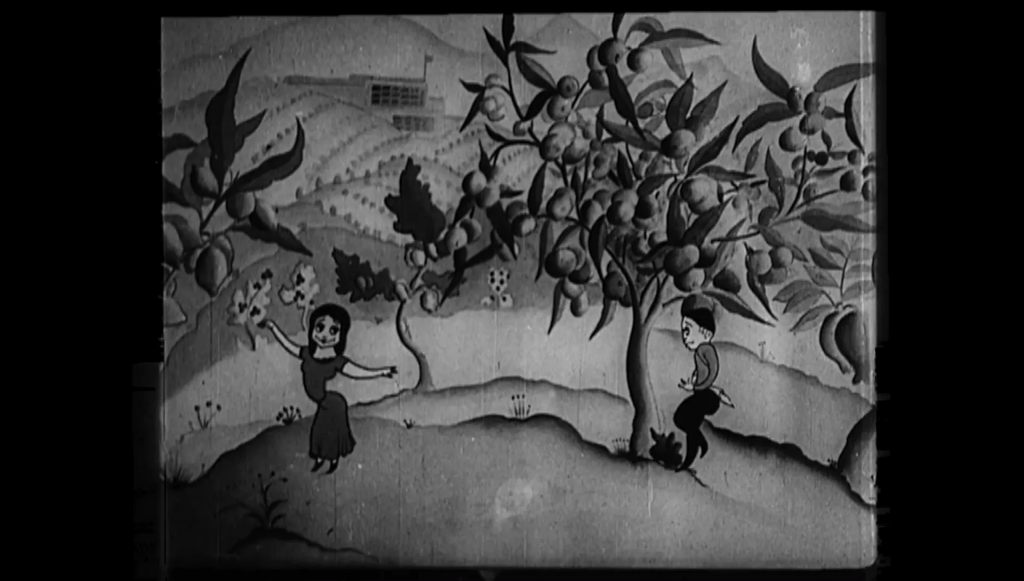
In 1936, after its incorporation into the USSR, the Republic of Georgia produced this short as its first animated film. The ten-minute film was not a straightforward retelling of Jason and Medea’s adventures in Colchis; rather, it deployed Jason as a symbol of the Soviet state’s “heroic” efforts to drain the region’s marshes and transform them into productive agricultural land. He promises Medea a garden, and undertakes to destroy the malarial mosquitoes and the cavalry of frogs that live in the area. Once he succeeds in this endeavor, he gives Medea the Golden Fleece and the two find seeds to plant fruit trees. The film appears to be the earliest animated treatment of Greek epic ever made in Russia.
Best known for his experimental work in sand animation, Ferenc Cakó here uses claymation to tell a more traditional tale – a fable of Aesop – but with many humorous twists. The film won the award for the Best Humorous Animated Film at the 2005 Kecskeméti Animáció Film Fesztivál.
43 min.; English; dir. Alessandro and Gloria Bulath, produced by AVO Film Edizioni
From the DVD cover: “Hercules, Jupiter’s favourite son and his little friend cloppete, King Krinios’ centaur son, are on a journey to the city of a Hundred Centaurs…what starts out as a mere stroll develops into one of his most exciting adventures! The adventure is also tainted with the prospect of Hercules meeting his true love! However Hercules must face an assortment of deadly enemies on his quest such as the multi-headed sea monster and the ferocious lion. The story delivers a series of cliffhangers where our hero is led to the dark and dangerous depths of the realm of the Dead World.”
This exceptionally low-budget, Italian-produced film is an “unofficial remake” of the Disney feature, “with the addition of elements ripped from the sci-fi/fantasy series Masters of the Universe,” according to Martin Lindner (‘Mythology for the Young at Heart’, 2017).
45 min; Japanese; based on a shojo manga series by Rurika Fuyuki
This romance and fantasy-inspired OVA anime adapts the story of Hades and Persephone, giving it a modern twist. Middle school student Arisa Sakura starts a fortune-telling club at her school. Through her rivalry with another student, the astronomy club founder, she learns that many students at her school are actually Greek gods reincarnated who still possess great powers. This includes Arisa herself, who is a second incarnation of Persephone, though she does not recall her past life. It also includes Amano Sho, a classmate who is Hades reincarnated and with whom she is destined to fall in love all over again. Amano recalls Arisa’s tragic past life experience and he does not to lose her again. He therefore fights to protect her, in particular from Zeus, who wants access to the unique power she holds: the ability to revive the Titan.
The storyline has some similarities with Sailor Moon and may have inspired it, though there is much more direct engagement with Greek mythology here.
8 min.; France; no dialog; dir. Simon BAU, Clémentine CHOPLAIN, Marie ECARLAT, Benoit HUGUET, Julien SOULAGE
In this student-produced CGI short, Cupid is on the job in modern-day Paris, bringing couples together with his arrows of love. However, one assignment goes awry when he gets distracted and shoots a young man twice. This causes the man to turn into a modern Narcissus, who falls in love with himself in his own reflection. Cupid’s attempts to rectify this situation take up the bulk of the film, which ends with an almost wholly successful resolution to the mix-up.
10 min.; no dialogue; Poland; dir. Lucjan Dembiński
An animated retelling of the classic tale of King Midas in puppet form. The film features no dialogue, only musical accompaniment (by Krzysztof Penderecki) and employs many ancient Greek and Minoan artistic motifs (especially the Snake Goddess figurine), though stylized to suit a 1960s aesthetic. In this regard, it is quite similar to Polish director Edward Sturlis’ “Orpheus and Eurydice [Orfeusz i Eurydyka]” from 1961. It also features the storyline originated by Nathaniel Hawthorne and represented in Ray Harryhausen’s 1953 animated version of the story, in which Midas has a daughter whom he turns to gold, but who then turns back to flesh and blood after the god Dionysus intervenes.
Swiss independent animator Georges Schwizgebel drew upon the story of Icarus and his fall in this film, the first he directed. The film’s unique pointillist aesthetic was created with “a black hole template laid over painted cels” (Bendazzi p. 198), which gives it a video-game like feel. The harpsichord musical accompaniment provides an element of gravitas to the playful animation, as it gives the impression that “the ‘bulbs’…are triggered by the harpsichord keys as they are played.”