5 min.; no dialog; dir. Rikke Alma Krogshave Planeta; Denmark
In this short film a young woman named Alex finds herself bored with modern life. During a night out with friends, she is lured by an androgynous and charismatic Bacchus into a colorful and mysterious world to explore her deepest desires.
The film was created as a student project at VIA University College in Denmark and was supported by The Animation Workshop. It won an Iris Prize in 2018 at the LGBTQ+ Film Festival.
In this episode of the long-running PBS show, Arthur, the titular aardvark’s little sister, D.W., composes an adventure story based on the Odyssey.
D.W. wants to hang out with her big brother Arthur and his friend Buster as they read together, but they exclude her because she is too young to read and write. D.W. gets upset and claims she can make a better story than what’s in the books, and Arthur challenges her to try. She expresses her frustration to her Grandma Thora about her inability to write a tale, but grandma responds by telling her how cavemen passed on stories by word of mouth (or, oral composition).
After this, D.W. recites a tale to Arthur and Buster about the warrior queen O-D.W-eus and her epic adventures, which is depicted in the animation with the show’s characters in the iconic roles. We first see the queen angering Poseidon (played by the monkey Francine) by stealing his unicorn. The god crashes the queen’s ship, but she and her crew of preschoolers survive. After eating plants that make them forget everything, they are seized by the Cyclops (played by the rabbit Buster). He eats a few friends in his cave, but O-D.W.-eus blinds the Cyclops — she ties one of his ears around his eye — and the crew escape using his boat and his sock as a sail. The boat passes by the island of the Sirens, who sing the song ‘Crazy Bus’ (a recurring song on the show), as the queen is tied to the mast. They pass between Charybdis and Scylla (played by the monkey Muffy and Arthur, respectively) and throw the Cyclops’ sock in Scylla’s face to escape once again. Finally, as they are reaching their home island, the boat is struck by lightning and only O-D.W.-eus reaches land, eager to share her story.
In the end of the episode, the boys at first claim D.W.’s story is no good. D.W. responds that they must not kow what a good story is, since she was telling them the Odyssey, which her grandma had shared with her. They then admit that it was actually pretty impressive, and ask her to tell parts of it again.
1 season: 12 episodes (23 min. each); Japanese; dir. Tomoyuki Kawamura; Brain’s Base / Sentai Filmworks
This anime series (KamiAso for short) was based on a popular pair of otome games, or a “story-based romance video game targeted towards women with a female protagonist as the player character,” made for PlayStation. In both the games and the series (which could be categorized as a reverse “harem anime“), a young woman named Yui Kusanagi discovers a magical sword that transports her to a different world where she meets the Greek god Zeus. Zeus is concerned about the weakening bond between humans and the gods, which he fears will bring about future disaster. He has therefore created a school where young gods go to learn the meaning of love. He asks Yui to attend to the school and teach these gods about the workings of the human heart.
Over the course of the series, Yui has encounters with eight gods that come from the Greek pantheon (Apollo, Hades, Dionysus), Norse mythology (Balder, Loki, Thor), and two Japanese divinities, Tsukito Totsuka and Takeru Totsuka, while the Egyptian god Thoth oversees their education. Yui spends various episodes “winning over” each of these gods by going through challenging experiences with them that allow them to bond. Zeus decrees that these gods cannot leave the school (or the world) until they graduate and their powers are shackled by special jewelry until that time.
One interesting storyline that is developed in Episode 9 involves Yui becoming aware of Apollo’s past love affair with Cassandra through a series of dreams she has. Cassandra possesses Yui’s body and appears to Apollo, which provides him with closure over the tragic outcome of their relationship. In the end of the series, after Balder commits suicide and attempts to destroy the universe, the gods band together to save one another and to return Yui to her own world. Each thanks her for the education she has provided them and Apollo confesses his love to her.
Inspired by a trip to the local museum, where they learn about Asparagus, the Greek hero who won every race with a golden chariot and petrified the Minotaur with the head of Medusa, the brothers Phineas and Ferb plan a chariot race for themselves and their friends that will run through their town. Three teams are assembled, with rocking horse-drawn chariots powered by lawnmower engines. One friend, Buford, proclaims, “There are no rules in a chariot race!”
Phineas and Ferb’s older sister Candace, in her typical fashion, tries to prevent the race from happening. Instead a helmet with snakes falls and lands on top of her head, making her look like Medusa, and in her confusion she ends up in a chariot too. Everyone attempts some underhanded tricks to get an edge in the race, but Candace ends up winning it.
In the meantime, the brothers’ pet platypus Perry is being chased by a robot named Norm. An ox-shaped helmet from a Paul Bunyan themed restaurant falls on the robot’s head, and everyone therefore believes he is the Minotaur. Back at the museum, Candace yells at this creature, thinking he is a human, but Perry switches him off. As Norm falls to the ground, everyone thinks Candace has turned him to stone. Even Candace herself comes to believe it when she encounters some stone statues, and the episode ends with Ferb still too scared to look at her.
The episode features the song “My Chariot”:
I’ve got a motorized nag Takin’ me for a drag Leave the others far behind Baby I ain’t braggin’ My anachronistic wagon’s Two millennia ahead of its time
Talking ’bout my chariot No, it’s not street legal But it gets me where I wanna go Climb aboard my chariot When they hear me come a-rumbilin’, Then everybody wants to know “Where’d you get that chariot?” I don’t need no oracle To tell me how good it feels To throw a full-tilt Colosseum, Killer toga party on wheels
Yeah yeah!
Yeah, talking ’bout my chariot Got a hundred horsepower And two big wheels of fun Climb aboard my chariot You can be my second ‘Cause I’m gladiator number one Get a load of my chariot Always going full-throttle Ask anybody and they’ll say If you see me a-comin’ Then you better get out of my way!
This film combines live-action human actors with puppets and stop-motion animation techniques to tell the story of the life of Hercules in a comedic fashion. The film’s aesthetic hearkens back to the days of silent film and features Vaudevillian antics and a slapstick style, accompanied by classical music by Wagner, Offenbach and Saint-Saens. It was made as the second part of a series on “Myths” that Ovcharov undertook in 1999, though only four short films were completed (including one on another ancient topic entitled “Pharoah”).
The film utilizes the conceit of vase painting, a common trope in animation about ancient Greece, to situate the story of the hero and bring it to life. It begins with a showcase of somewhat random gods (e.g., Themis, Eros, Hephaestus, Cyclops, Poseidon, Sisyphus?, Dionysus, Asclepius) partaking in their quintessential activities, though in a silly or overblown fashion. We zoom out to see all of this taking place on a massive amphora with the word Olympos etched on it.
Next the screen goes black and the following words appear translated into various languages: “The thunderer Zeus sired the extramarital son Hercules. Zeus’ wife Hera jealously persecuted Hercules. Hercules’ life consisted of cruel violence and worthless feats.” The opening credits appear as well as an image of the hero on a vase, and as it turns we encounter a creepy Greek chorus, who begin to sing in a bombastic manner. Zeus and Hera cavort and watch from the clouds above as the cries of a baby signal the birth of the hero below. Hera gets upset at this turn of events and begins pantomime fighting with Zeus, which parallels the tussling of Alcmena and Amphitryon on earth below. Hera throws the snakes down from heaven and an already full-grown Hercules in a diaper successfully fights them off.
Next Eurystheus arrives and lures the hero to embark on his labors by offering him the club. Hercules pees on his cousin before taking up the club, much to Amphitryon’s delight. Eurystheus leads him onto another vase and to the Nemean lion, which he overcomes. A centaur appears and attacks Eurystheus’ men. A Centauromachy ensues that includes the Centaurs pooping in a projectile fashion toward their enemies. One captured centaur poops so voluminously that it fills the scene. Hercules washes it away with a vase, in a nod to the cleaning of the Augean stables. Scenes of Zeus, Hera, and the chorus observing all of these hijinks are interspersed in these labors.
Hera freezes Zeus in a cloud and conjures up a monster (the Hydra?) out of a storm cloud. After dispatching it handily, he is surrounded by a band of attacking Amazons. They battle but the Amazon queen becomes enamored with him. Eros shoots the unwilling hero with an arrow, and we next see him in women’s clothing, knitting indoors. This seems to be an allusion to the story of Omphale, the Lydian queen who enslaved Hercules and played at cross-dressing with him as a part of their sexual games. After the arrow in his shoulder is retrieved by Eros, he is restored to his old self and attacks the Amazons and some children, killing them all.
We segue to a final vase where the story of Deianeira and the Centaur Nessos plays out. He provides her with a belt that she offers to Hercules in her jealousy at his flirting with some other women. He puts it on and catches fire, then takes off like a rocket to the heavens as Deianeira kills herself in despair. The hero kisses his father Zeus and kisses Hera too, while back on earth we see people celebrating his apotheosis with drinking and dancing (Dionysus and Poseidon make another appearance here). The film ends with a Dionysian revel and a zoom out that shows all of this happening on the Olympos vase with which the film began.
In presenting the story of Hercules as a comedy, Ovcharov maintains a long tradition dating back to antiquity, where the hero was frequently depicted as figure of humorous excess.
3 min. / Modern Greek / Directors: Anna Samoylovich & Yelizaveta Skvortsova; Metronome Films
This brief video features a musical performance of the traditional modern Greek lullaby, “Nani Nani”, accompanied by stylized animation that features a mother putting her child to bed by reading a storybook. He dreams of various moments from Greek epic mythology, including Odysseus and the Sirens, the judgment of Paris, the Trojan Horse, and the Cyclops. Iconic aspects of ancient Greek culture — the Olympics, architecture, and theater — are featured in subsequent vignettes. The child awakens suddenly to the image of Icarus of falling from the sky, and realizes he has been dreaming.
12 min; French (Chinese subtitles); dir. Michel Ocelot
[Note: This film can be viewed with English subtitles on the 2008 DVD, Les Trésors Cachés de Michel Ocelot, but it requires a region 2 DVD player]
Famed French animator Michel Ocelot’s episode “Icare” is one of eight from his 1989 TV anthology series Ciné Si (“Cinema If”) (sometimes also known as Princes et Princesses). It utilizes spare silhouette animation to tell the story of Icarus and his father’s flight of escape from King Minos. The myth is embedded in a larger frame story:every evening, an animated boy and a girl meet in an abandoned cinema to imagine new stories; with the help of an old projectionist and his pet owl, they use computers to choose a historical moment or piece of art as inspiration, then they define their characters, design costumes and music, and act out the stories as the main protagonists.
Ocelot depicts the myth in a positive light that celebrates the ideals of discovery, invention and transformation. Father and son formulate their plan to escape by using feathers to create wings, then make their escape from the labyrinth. Icarus proclaims he wants to be the first mortal to see the chariot of the sun as he flies, while his father pleads with him to save his strength and avoid being burned. After touching the chariot, he falls into the sea, but a dolphin rescues him and carries him to the shore! He then encounters two girls playing ball who resemble the famed Minoan “snake goddess” statuettes. In a scene very reminiscent of Odysseus’ encounter with Nausicaa in Odyssey 6, one girl runs away in fear but the other approaches the youth and welcomes him “to the shores of King Nikeas.” She identifies herself as Kallimera (modern Greek for “Good Morning”), a fish merchant’s daughter, and tells Icarus that she will believe his story of how he came to walk out of the sea if he tells it to her. The film ends with the two figures gazing at one another in profile as a triangular-shaped variation on the “iris out” technique encloses them and romantic music swells.
This romantic spin on the tale is wholly unique, and as the credits roll, a voiceover acknowledges that it is not that of the original. This choice may have softened the story for child audiences, or helped to incorporate a female element in the film.
From Lesley Keen’s YouTube page: “Invocation originated as a sequence within the documentary Orpheus Through the Ages made by Pelicula Films to accompany Orpheus and Eurydice [her animated film from 1984]. It was designed to illustrate the Ancient Greek myth of the Creation of the world. It was shot on 16mm and subsequently enlarged onto 35mm for festival screenings. The techniques employed were a test run for those which ultimately were used within Ra; the Path of the Sun God [her feature film from 1990].” This film, like Orpheus and Eurydice, was made as commissions for UK’s Channel 4 in the 1980s.
What she does not mention here, but quickly becomes evident from the narration of the film (click for transcript), is that this is a variation on the Orphic myth of creation from ancient Greece, which differs significantly from the more canonical version of creation in Hesiod’s Theogony, which is known best to us moderns.
The mystery cult of Orphism was an alternative to traditional religion centered on the teachings of Orpheus, who acquired divine knowledge when he went to the underworld. The cult revered the god Dionysus (sometimes known as Zagreus), who, in this belief system, was born of the union of Persephone and Zeus, and who was killed and consumed as a baby by the Titans. Zeus blasted the Titans with a thunderbolt and humans were formed from the resulting soot, which contained a bodily element from the remains of the Titans and a divine element from those of Dionysus. Initiation into the cult allowed humans to transcend this evil, bodily element and break the grievous cycle of reincarnation to which we are subject.
In Orphic belief, there were other, less familiar entities who facilitated the emergence of creation long before Zeus and the Titans came into being. These include Time, Necessity, and Aether, who created the cosmic egg, out of which Phanes (sometimes Eros), a bisexual deity, was born. Phanes’s union with Night gave rise to Heaven and Earth (aka Ouranos and Gaia) who then created the Titans and Zeus. Zeus then consumed Phanes and recreated the world. It was then that the birth of Dionysus outlined above took place.
Impressively, all of this is represented in dynamic terms in Keen’s mesmerizing experimental film, and in less than four minutes. Using simple line drawings on a black background, colors and symbols in motion, and an alien-inspired synth soundscape, she brings to life one of the most mysterious myths of the ancient world.
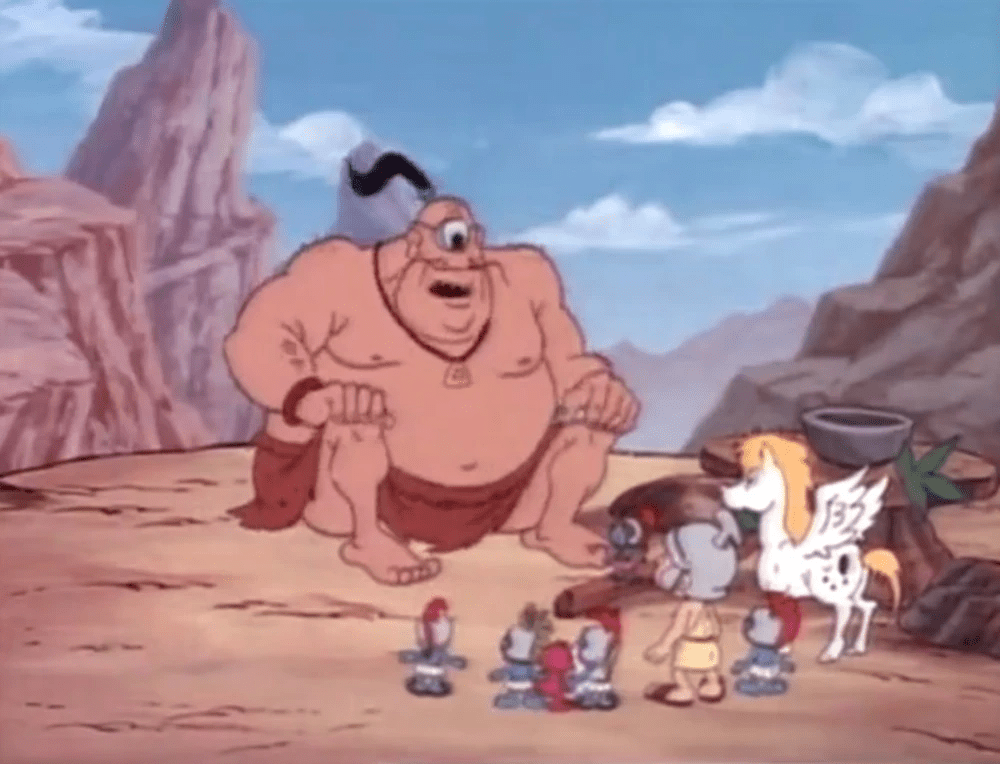
“The Smurf Odyssey” is part of the final season of The Smurfs TV show, which deviated from past seasons by featuring time-travel episodes, including several set in the ancient world, such as “Hogapatra’s Beauty Sleep,” “Trojan Smurfs,” and “Gnoman Holiday.”
This episode, in which the Smurfs help a reluctant Hermes, son of Zeus and Hera, as he attempts to complete a coming-of-age quest so that he may prove himself worthy of his divinity, is a remix of various epic narratives. It is actually structured more explicitly around the story of Jason and the Argonauts, in particular the version of the story told in the 1963 Don Chaffey film that featured the creatures of Ray Harryhausen, rather than Homer’s Odyssey. Retrieving the fleece is the main aim of Hermes’ quest, and along the way the gods on Olympus watch his progress in a reflective pool of water, like in the film. They travel on a ship with a talking “spirit guide” named Sylvia, recalling Athena in the film; they also encounter a hydra and in a direct nod to the film, they battle a legion of skeletons that come to life from stalactites that fall to the ground in a cave!
Their encounter with a Cyclops is the only Odyssean element featured in the episode, but this Cyclops turns out to be a lonely scaredy-cat who is in need of friends. After befriending the Smurfs, the Cyclops (whom they affectionately call Loomis?) helps them out in their fight against the skeletons.
The final task of the quest is to sail to Gorgon Island and face the monsters that turn people to stone who are guarding the fleece. This aspect draws on the legend of Perseus, of course, and the Pegasus also plays a prominent role throughout the episode. Hermes finally shows off his bravery and heroism when he rescues the Smurfs who have been turned to stone and takes the fleece, and happily he is rewarded with divine status by his father at the end of the episode.
48 min. / English / Burbank Films Australia / dir. Geoff Collins and Warwick Gilbert
A low-budget adaptation of Homer made for television. It begins with a council of the gods, who review the highlights of the Trojan War and discuss the fate of the hero Odysseus. It then cuts to his adventures as he attempts to get home to Ithaca.
The first adventure is that of the Cyclops, after which Zeus gives Poseidon permission to hinder Odysseus’ journey home. A storm blows the ship to the island of Circe, where the men are turned to pigs. Odysseus is helped by Athena to resist Circe’s magic; afterward Circe gives him a map to Hades, where he is to consult Tiresias about how to get home. He crosses a suspension bridge and talks to Cerberus, then throws a pebble into a bloody lake to get Tiresias to appear. Tiresias tells him he will face the Sirens, Charybdis and Scylla (who will eat six of the crew), and then reach the Island of the Sun God, where they are not to touch the sheep or cattle. Poseidon causes an earthquake which damages Hades and Odysseus narrowly escapes.
The canonical adventures proceed as promised by Tiresias, though Poseidon does show up to create another storm on the Island that compels the men to kill the cattle. Zeus punishes the men by creating an eclipse and striking the ship with lightning. Odysseus is saved by Athena, and recalls his adventures in flashback before washing up on the shore of an island where he encounters the princess Penelope!
From this point, things get pretty weird, in a mash-up of a various mythical traditions: Odysseus is brought to the king and queen of Phaeacia who welcome him as a famous hero. But soon word is brought that Poseidon is demanding his annual sacrifice of a young girl to ensure smooth sailing, and this year he demands Penelope. Odysseus appeals to Athena for help. She tells him the princess will be tied to a stake in a cove and Poseidon will emerge to take her back under the sea. He will reduce his size to that of a mortal and at that point Odysseus can grab him and hold on to him as he shapeshifts, then ask him to grant him a wish. After transforming into multiple animals, Poseidon agrees to leave off the annual maiden sacrifice and to let Odysseus live in peace. Odysseus then asks Penelope to be his wife and sail home to Ithaca with him. The film ends with the gods discussing the outcome, and acknowledging that Odysseus will have more adventures in the future, and that only he among mortals can deceive a god.

 Animated Antiquity